06 September 2011

Rosenwind


It was a foggy day on Lake Attersee, so Gustav Klimt couldn’t see across the water through that telescope.  We know that he used the telescope to  frame the  elegantly untethered landscapes he painted.  He was not being serious about looking on this particular occasion, his face  turned slightly toward the photographer.  If we didn’t know about his vanity, we could intuit it from the cumberbund he is wearing that accentuates the barrel shape he  acquired in middle age more than it restrains it.


The introduction of photography and of Japanese art to western audiences occurred during the same period, a happy coincidence that has kept legions of art historians busy ever since, trying to assign blame or influence, depending on your preference.  We also know that Klimt turned his opera glasses on objects close at hand, a technique that produced results which resemble what a near-sighted person sees when they go outside without glasses.  Such assaults on the perfection of Renaissance perspective have often been viewed as illegitimate means, regardless of ends.  As recently as thirty years ago, curator Peter Galassi’s exhibition Before Photography at the Museumof Modern Art was received skeptically, its examination of cross-influence between the two media dismissed as a parlor game.


Lake Attersee, situated in western Austria, is far removed from the hectic life of the capitol city.  Not that Klimt didn't enjoy being over-stimulated but, away from the distractions of so many attractive Viennese women, the artist  found an atmosphere conducive to working with landscape.  Both sublime and subliminally inspiring is the famed  Rosenwind, an easterly wind off Lake Attersee that carries the fragrance of a thousand roses from a castle garden, perfuming the air with magic.
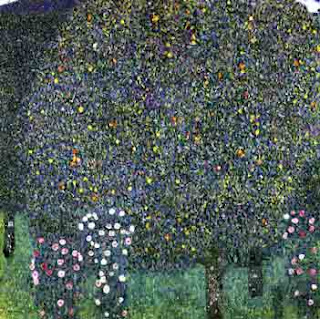


When I visited the Klimt  landscape exhibition at the Clark Art Institute I saw Arthur Schopenhauer's idea of nature's chaos brought under the control of art.  From close up, Klimt's brushstrokes appear abstract but back off and they represent flowers, trees, and water (but seldom sky) while remaining noncommittal, a very loose form of verisimilitude indeed.


Buildings inhabit space almost as an afterthought, as though these gardens were not also human creations.  The orderly looking farmhouse seems no match for its surroundings,  a Freudian image of emotion's triumph over reason.  Klimt's attitudes toward nature, human and otherwise, were pessimistic and regressive.  He wrote once that he yearned to find a place where "fate will allow us to enjoy our pleasure."  This from a man whose self-indulgence needed more than a cumberbund to restrain it. 


Gustav Klimt Landscapes was one of four exhibitions at the Sterling and Francine Clark Art Institute (other displayed the works of architects Otto Wagner and Josef Hoffmann and the painter Bernardo Bellotto) were part of the Vienna Project at eleven institutions of art, music, and theater in Massachusetts during the summer of 2002.
Images:
1. unidentified photographer - Gustav Klimt and his telescope, c.1905, courtesy Clark Art Institue, Williamstown, MA.
2. Gustav Klimt - Italian Garden, 1913, Kunsthaus Zug/Foundation Kamm Collection, Switzerland.
3. Gustav Klimt - Fruit Orchard With Roses, c. 1911, courtesy Clark Art Institute. Williamstown, MA.
4. Gustav Klimt -  Roses Under the Trees, 1905, Musee d'Orsay, Paris. (to be restored to its original owners who sold it the Nazis under duress  - March, 2021)
5. Gustav Klimt - Farmhouse with Birch Trees, 1911, Belvedere Galerie, Vienna.
 6. Gustav Klimt - Forest Slope in Unterach on the Attersee, 1916, private collection, courtesy Clark Art Institute,

06 August 2011

Proscenium: Joseph Urban


“You could have what you wanted of [Urban’s] gifts – fantasy, realism, abstract decoration, architectural solidity.  He could do superbly many things that his contemporaries could not do at all. “ – Deems Taylor in Architecture, May 1934.


 In  Urban's hands, assimilation became creativity of the highest order.  He brought medieval styling to a bridge for the Hapsburg Emperor and japonistic elements to stage sets for the Ziegfeld Follies.  Growing up in fin-de-siecle Vienna, he was immersed in the contemporary  Jugendstil movement.    Urban founded a design group, the Hagenebund, that was similar to Otto Wagner’s Secession, but more devoted to the style of Art Nouveau.  You can see the medieval  influence on Art Nouveau clearly in Urban’s work.


Born in Vienna,  Joseph Urban (1872-1933) studied architecture at the Royal Academy of Fine Arts.  He was only nineteen when  he received his first commission from  the Khedive of Egypt: to design a a new wing for the Abdin Palace.


During his eight months  in Cairo Urban fell in love with  deep blue of the Mediterranean,  a color that would be a prominent feature of his  theatrical designs.  “I think the indescribable  blue of the Egyptian sky created my lifelong love of blue;” Urban admitted.

Returning to Vienna, Urban's good fortune continued.  He obtained a position in the office of the official architect to the Emperor Franz Joseph, where  he received the commission to design the new Kaiser Bridge to celebrate the 50th jubilee of the emperor’s reign in 1898.  


As you can see from his design for the Esterhazy Palace, Urban applied his taste for theatrical settings to real life.  Even the Esterhazy fireplace (one of them, anyway) has its own proscenium arch above the curved blue oval.  There is even something Egyptian looking in the design of the chimney.  Urban seems to have been one on whom nothing was lost.


 Fabulously successful in Vienna, Urban could have stayed put but, in 1912, he emigrated to the United States to become the art director of the Boston Opera Company.  His first production, The Tales of Hoffmann,  caused a critic to enthuse about its " perfect atmosphere and illusion."  Urban explained his new concept of the theatrical thusly: " The new art of the theater is more than a matter of scenery; it concerns the entire production. The scenery is vain unless it fits the play or the playing or unless they fit it. The new art is a fusion of the pictorial with the dramatic. It demands not only new designers of scenery, but new stage managers who understand how to train actors in speech, gesture and movement, harmonizing with the scenery."


Soon,  Urban's services were in demand In New York, by everyone  from the Metropolitan Opera to the Ziegfeld Follies.  For the Met, Urban made use of his Jugendstil background; Suzanna's boudoir came straight from Vienna.  For impresario Florenz Ziegfield's bevy of beautiful women, Urban created...bubbles.


Vienna and architecture  had been Urban's first inspirations and he returned to both in his work, if  not in life.  He designed the Manhattan showroom for the Wiener Werkstatte, the design group whose hopes of bringing good design to the masses were frustrated by high prices.  Ironically, Urban was to design an emporium that really did reach the masses - the 1928 Kaufmann's Department Store in Pittsburgh.
 In Urban's hands, the proscenium arch of ancient Rome had become the setting for magic in an Art Deco world.

Images: the Joseph Urban Archives, Columbia University, NYC, unless otherwise noted.
1. Joseph Urban - Ziegfeld's Follies, 1916.
2. Adolf Bohm - Children's Room for the Wiener Werkstatte, 1909, Brandstatter Archive, Vienna.
3. Joseph Urban - Tinture's Vision from Parsifal, 1920.
4. Joseph Urban -  The Kaiser Bridge, 1898.
5. Joseph Urban - Exterior of Esterhazy Castle, Hungary, 1899.
6. Joseph Urban - Interior with Fireplace - Esterhazy Castle, 1899,
7. Joseph Urban - Set for The Secret of Suzanne by ErmannioWolf-Ferrari, 1913.
8. Joseph Urban - The Century Girl for Ziegfeld's Follies, 1916.
9. Joseph Urban -  Kaufmann Department Store - Pittsburgh, July 1928.
10.  unidentified photographer - Wiener Werkstatte showroom - NYC, 1922.

29 July 2011

Charles Zoller: Autochromes From The House Of Kodak


Each spring  the gardens of the George Eastman House in Rochester, New York are bright with red and yellow  tulips, the colors of  Kodak, the company George Eastman (1854-1932) founded.  Eastman  invented roll film in 1885 and introduced the Kodak camera three years later. 

It seems that Rochester was destined to be the perfect city for amateur photographers.  Early in the 19th century he western New York city was known as the 'Flour City' for its grain mills and waterways but by the time Eastman came to town, the nickanme had morphed into 'Flower City'  for its numerous  commercial nurseries.   

 So successful was Eastman Kodak that as this advertising wagon in 1922 bragged that its hometown had become the Kodak City.  You'll notice that the photographs in display are in black and white.   Eastman Kodak  did not introduce its fabulously successful  Kodachrome color film until 1935.  George Eastman died in 1932, but the man who liked bold colors and bold ideas probably would have liked the song that Paul Simon wrote about his most successful product.


"When I think back
On all the crap I learned in high school
It's a wonder
I can think at all
And though my lack of education
Hasn't hurt me none
I can read the writing on the wall

Kodachrome
They give us those nice bright colors
They give us the greens of summers
Makes you think all the world's
a sunny day
I got a Nikon camera
I love to take a photograph
So mama don't take my Kodachrome away

If you took all the girls I knew
When I was single
And brought them all together
for one night
I know they'd never match
my sweet imagination
Everything looks worse
in black and white."
 - Kodachrome by Paul Simon, 1973, from There Goes Rhymin' Simon, Columbia Records.

But there's more to the development of color photography than American triumphalism.  There's the autochrome, introduced in 1907 by the Lumiere Brothers of France.  Although unstable and not easy to work with, it produced evocative color images that exist in relation to kodachrome as analog does to digital recording.   

American Pictorialist photographers, notably Edward Steichen who was born in Luxembourg and lived in France off and on, took up the new technique.  But professional photographers in the United States lost interest rapidly after their initial enthusiasm.   A  plausible explanation is that Alfred Stieglitz, in developing a rationale for photography as art,  made no place for color.  There is very little of it in his enormously influential journal Camera Work.

Enter Charles Zoller.   Zoller (1856-1934) was a successful furniture dealer from Rochester,  who happened to be in Paris in 1907, hust as the new process was unveiled.   Already interested in photography, he took up the autochrome immediately and may have been the first American amateur to use it.


Over the ensuing decades,  Zoller documented life in the Flower City with autochrome while his contemporaries stuck with black and white.  Once dubbed America's first boomtoom, Rochester is a city with neighborhoods full of gracious houses in a potpourri of styles surrounded by the upstate wine country of the Finger Lakes.  There was no shortage of appealing subjects for Zoller to turn his camera to.


The man who often rode around Rochester on his high-wheel bicycle had a sense of fun.  There are pictures by Zoller that make me smile, even as I wish he had left some written explanation for what was going on.  Whose horse was watching those cultivated roses?  Whose birthday was the occasion for a giant outdoor cake delivered by a dancing fairy godmother? 


And what enterprising farmer/gardener devoted a large field to  this floral American flag?  I want to know what kind of fruit was on those trees - apples, cherries, plums, peaches?


Although one town (Aurora)  in the Finger Lakes tried  advertising itself as "the Miami of the north",  the upstate region could just as well be dubbed 'East Alaska' for the unpredictability and harshness of its winters. 


 In pursuit of his avocation., Zoller toured the country several times,   down the coast to Florida and then  across the southwest to California.  He  met - and photographed -  actor Charlie Chaplin in 1918. 

 
Around Hollywood and Los Angeles Zoller photographed garden court houses and imitations of Japanese architecture, as well as new flora like the rows of giant cone-shaped Honey Plant lining a street in Beverly Hills.


When Zoller began visits to Florida around 1920, it was just about to become a popular vacation spot.  With the smallest population of any southern state and cheap real estate, you could buy fresh oranges directly from farmers at their roadside stands and there was no one to stop you from driving your car onto the beach.
 It's difficult now to retrieve the wonder that Zoller's friends and acquaintances probably felt when they looked at his albums.  We're jaded now, with our disposable cameras and fingertip media, we take the power and beauty of images for granted.


Zoller photographed this Arizona rock formation in 1909.  I think it was the eye hole, the aperture if you will, that attracted him.  To see, to document, to share was his avocation.  From grains of starch, lampblack and silver emulsion these images were fixed, except that sometimes, like the snows of upstate New York, they drift.


George Eastman House  presented the exhibition Rochester In Color: The Autochromes of Charles Zoller in 1988.


Images: Approximately 4,000 autochromes by Charles Zoller  are in the collection of George Eastman House, International Museum of Photography and Film, Rochester, NY
The majority are  dated c.1907-1932, the years during which Zoller photographed..