03 January 2023

A Predilection For Onions: Mary Ann Currier

"How easily happiness begins by

dicing onions. A lump of sweet butter

slithers and swirls across the floor

of the saute pan, especially if its

errant path crosses a tiny slick

of olive oil. Then a tumble of onions."

 - an excerpt from "Onions" by William Matthews which first appeared in Poetry in August 1989

Something about a still life painting turns its subjects into objects of desire. That is what happens in Mary Ann Currier's Onions and Tomato.  I want to chop them into small pieces and make soup. Three onions and a tomato, round, shiny, and luscious, guarded by a utility knife and a pot that functions as a mirror as well as a receptacle

Mary Ann Curries (1927-2017) had a predilection for onions. Currier chose onions as a favorite subject for their humble origins in fields of muck, the subtle variations in their color, and because they maintained their freshness while she finished painting them. She painted only from real fruit and vegetables, never from photographs although the realism of her paintings is breathtaking. 

Currier was born in Louisville.  Her parents emigrated to the United States from  Germany after World War II.  She studied art with many GIs, often being the only female in her classes.  She did advertising spreads, stationery, and then moved on to portraiture, finally finding her niche as a still life painter.  She had her first exhibition at the relatively late age of fifty.

Image : Mary Ann Currier - Onions and Tomato,1984, oil pastel on mat board, Metropolitan Museum, NYC

04 December 2022

Stephen Mueller: Orpheus the Enchanter

Everyone is smitten with the half-man half-god that was Orpheus.  Even the skeptical Carol Ann Duffy sounds sneakily admiring about: 

"the kind of a man
who follows her round
writing poems,
hovering about
while she reads them,
calls her his Muse,
and once sulked for a night and a day
because she remarked on his weakness for abstract nouns."
 -  Carol Ann Duffy, from The World's Wife Vancouver, Anvil Press: 1999.

Is he  a charlatan?  Who cares when he is such an enchanter?

Here we are light years away from the nightmarish vision of the Jan Brueghel the Elder, a  world inhabited by lizards in red nightcaps, moths with owls' heads and a couple marooned in a boat in the branches of a tree. Monteverdi in 16th century Mantua emphasized the tragic undertones in Orpheus' music. There is a deliciously comic aspect to Mueller's Orpheus.  His multicolored lyre entrances humans and animals alike, its notes float in the air like so many joyous balloons.

Stephen Mueller (1947-2011) was an American painter whose work was never completely abstract; he incorporated spiritual motifs from Persian miniatures to Mexican ceramics.


Image: Stephen Mueller, Orpheo 2, 2010, acrylic on canvas, Munson Williams Proctor  Arts Institute, 
Utica

16 November 2022

Jane Freilicher: Dark Afternoon

"Light is like oxygen in a painting;  without it a painting is dead. It doesn't breathe. " - Jane Freilicher

As we change our clocks, the effect of seasonal light is on our minds. 

Dark Afternoon was painted from Freilicher's lower Manhattan apartment in late autumn. Gray light coming in through the window gives no explanation for the concentrated liveliness of the plants on the yellow tablecloth or its source. It's  focus is on  the light  in retreat.  Freilicher used her  home as her studio. Her still lifes are not posed; they just are. She never strayed far from home, dividing her time between the city and Water Mill, Long Island.   
 
Unlike, say,  artists beginning with  Chardin, Freilicher did not isolate her subjects against a neutral background. This tradition in still life painting began in 17th century Europe. Then in the 19th century the still life began to appear in landscapes.

Freilicher does not seem preoccupied with composition, the resulting effect is one of freshness. Her paintings are filled with specific details but the artist withholds narrative cues.  Rather, she integrates them into a natural backdrop - landscape becomes part of the still life. The two elements remain separate but share a common ambience. Domestic and natural settings have a relaxed relationship as they do in life.  For her objects become events to be regarded with curiosity. 
  

Image; Jane Freilicher - Dark Afternoon, 2001, oil on linen, Munson Williams Proctor Art Institute, Utica

06 November 2022

Ruby Sky Stiler

"Let's not shame our eyes for seeing. Instead, thank them for their bravery."
  - Joy Harjo, from Conflict Resolution For Holy Beings, W.W. Norton, New York: 2015


The place of the occupational self portrait in the history of painting stretches back more than five centuries. Catharina van Hemessen at her easel, painted in 1548, may be the first self portrait by an artist.  A painter of the Flemish Renaissance, van Hemessen was born in Antwerp 

Ruby Sky Stiler joins the estimable company of such painters as Judith Leyster, Sofonisba Anguissola, and Elisabeth Vigge le  brun. Self Portrait with Blue Palette demonstrates the artist's familiarity with both ancient and modern techniques, making for a stimulating blend of Native American pottery  and weaving with flattening elements borrowed from cubism. I even detect  hints of the black and white chairs designed by Koloman Moser  for the Purkersdorf Sanitorium in 1903. You can have fun with Ruby Sky Stiler's work, spotting various combinations of elements.

Born in Portland, Maine in 1979 Ruby Sky Stiler studied art at the Rhode Island School of Design and the School of Art at Yale University.  She lives in New York City.

November is Native American Heritage Month.

For further reading:
Everything You Think you Know About Indians Is Wrong by Paul Chait Smith University of Minnesota Press, Minneapolis: 2009
We Had A Little Real Estate Problem by Klipf Nesteroff, Simon & Schuster, New York: 2021.


Image: Ruby Sky Stiler -  Self Portrait with Blue Palette - 2018, acrylic paint, acrylic resin, paper, glue, graphite on panel, Nicelle Beauchene Gallery, NYC.

26 October 2022

Hilary Mantel: Stories Of Her Youth


Learning to Talk, originally published in Great Britain in 2003, is likely to be  the last book we will ever have from Hilary Mantel. Mantel died suddenly in September of 2022. Her publisher described her, accurately I think, as one of Britain's greatest novelists.

In her introduction to this new edition, Mantel gives us to understand  that the stories  sprung from her memories if her own childhood in a northern England "scoured by bitter winds and rough gossips tongues. "All the tales arose out of questions I asked myself about my early years. I cannot say that by sliding my life into a fictional form I was solving puzzles - but at least I was pushing the pieces about"

The rigid class structure  that governed  postwar Britain makes itself felt early and often, The little girl is sent to elocution lessons because " I hadn't learned to talk proper."  "(E)veryone was policed by gossip," she remembered.

"Curved is the Line of Beauty" concerns her mother's new boyfriend Jack Mantel who comes to live with the family is "your definition of a man, if a man was what caused alarm and shattered the peace."
Her mother defied the conservatives mores of that time and place by living  for a time with two men, two more than her Catholic religion would approve. "Mercy was a theory I had not seen in operation. I had only seen how those who wielded power extracted maximum advantage from every situation."Then when Hilary was eleven the family, except for her father, moved away to escape the local gossip and Hilary never saw her father again.
. 
Mantel's descriptive powers are deceptively simple. She describes a neighbor girl as "meager like a nameless cut in a butcher's window;" a missing pet is "only my stepdog." Or this, "(W)e continued to live in one of those houses where there was never any money, and doors were slammed hard." Words that stay with the reader.
 
Image: Milton Avery - Poetry Reading, 1957, oil o canvas, Munson Williams Proctor Arts Institute, Utica

18 October 2022

Raymond Han: The Many Shades of White


"Look how white everything is," Sylvia Plath marveled in her poem "Tulips." That's what I think when I look at paintings by Raymond Han. Of course these shades of white contain colors as you will know if you have ever watched white paint being mixed in a store. 

An embroidered cloth  gives structure to the china arranged on the table. A cream pitcher is the focus of the picture. A blue and white teapot is decorated with japonisme; opposite is a Japanese cup. Greenery in a small cup is a touch of unruly nature in the midst of order. A spoon, a fork, a desert plate, and a few other small items complete the tea table. Why does that teapot seem subservient to the cream pitcher?

I have looked at Still Life with Rose Geranium in person several times. Fittingly, a print of it hangs  in the Terrace Cafe at  the museum. It was my introduction to Raymond Han whose bravura handling of shades of white is the signature of his still work. A gentle version of photorealism, in contrast to the sharp edges in the work of Janet Fish or Richard Estes.

The term still life appeared in late 16th century Netherlands; in French it is nature morte or 'dead nature'.  Intriguingly, the objects in a still life often appear to have individual personalities.

Raymond Han was born in Honolulu, Hawaii and lived near Oneonta in upstate New York for several years before his death in 2017. Han was one of seven children born to Korean immigrants. First he earned a scholarship to the Honolulu Museum of Art; then he moved to New York City where he studied  at the Arts Students League.

Image: Raymond Han - Still Life with Rose Geranium Sprig,  1980, oil on canvas, Munson Williams Proctor Art Institute, Utica

08 October 2022

Jaune-Quick-To-See-Smith


 "Where we lived, the settlers built their houses. Where
we drew fresh water, the oil companies sucked oil.
Where deer ran in countless numbers, we have a new
mall. Where the healing plants thrived; the river s
burning. Now, a fence cuts the road home. Next the sky
will be tethered and we will pay for air."

   -"Where we lived, the settlers built their houses." by Joy Harjo, from Conflict Resolution For Holy Beings, New York, W.W. Norton: 2015

Native Americans live in a post-genocidal world; this fact is embodied in the cartographic art of Jaune Quick-to-see Smith. Using paint, prints, and collage Smith obliterates the familiar political borders imposed on the land by white settlers.

For Smith, painting is a meditative process. Satire is a tool she uses to highlight stereotypes about Native peoples. "My art, my life experience, and my tribal ties are totally enmeshed. I go from one community with messages to the other, and I try to enlighten people." As an example, in one painting of the country she removed  the names of states except those American names - 27 of them when translated into English.

Jaune Quik-to-see was born on a reservation in Montana. Smith's first memory of making art was of dragging a stick through the dirt when she was three years old. As a small child, she treasured animal drawings of Growing up in poverty the girl found a way to create her own, more satisfactory world. Her pictures were a way she could share something with her father, an illiterate horse trader. Like many Native children of his generation, he had been taken from his family and sent a boarding school for deracination; when he spoke Salish, his mother tongue, the boy was beaten. 

As a teenager, she was told by a counselor that "Indians don't go to college."  When she persevered and enrolled at a college in Washington State, a professor told her that women couldn't be artists. She eventually earned an MFA in Visual Arts from the University of New Mexico. Fortunately, she ignored the advice. Smith only began to show her art in New York at age thirty-nine. Her work has received numerous awards over the years.

 mage: Jaune-Quick-to-See Smith,  2021 acrylic and collage on canvas, courtesy of Garth Greenan Gallery, NYC.

27 September 2022

Pablo Picasso: Boisgeloup In The Rain


Paul Verlaine  described rain as "long sobs of Autumn's violins."
Admittedly, this painting by Picasso shows us spring rain but I think the epigraph fits.
 

Boisgeloup is an old stronghold dating from the Middle Ages. The town is located in the French region of Haute-Normandie. It became the home of Pablo Picasso in 1930. He Made a studio where he built sculptures in plaster, iron, and bronze. On the property there was a large outbuilding where he installed a press for engraving. He lived there for six years with his mistress Marie Therese Walter while his wife Olga stayed in Paris.  There is a small museum L'Atelier du sculpteur that displays his works. 

Image - Pablo Picasso - Boisgeloup in the Rain, 30 March 1932, oil on canvas, Musee Picasso, Paris.

18 September 2022

Stella Polaris: Helen Frankenthaler

There was always more subject matter in abstract painting than artists were willing to admit. The title may have been an allusion to a work by the 18th century French philosopher Voltaire. Frankenthaler used the three primary colors; then white was layered over them in a series of ..gestures.

Her precociousness was well known; at twenty-three Frankenthaler was already able to command the controlled freedom (yes!) which became her trademark.


Her color field paintings with their stains and washes of color are always less monochromatic than they appear at first glance. She  usually laid the paint on heavily at first and then washed over with water. Marks, spatters and a wide variety of technical means.  At least once, in 1976, she employed a window cleaning blade on a long handle to get the effect she was after. A number of Frankenthaler's works have elements of overt subject matter in them.  Of Faerie Tale painted in 1976 she remarked matter-of-factly that is was a painting of a window but then added,  "I don't know whether I meant or just this second projected that image." 

In response to the strictly gendered stereotypes of the 1950s, Frankenthaler held herself aloof with the press. "There are three subjects I don't like discussing: my former marriage, women artists, and what I think of my contemporaries."   Fortunately, Frankenthaler lived to see better days and greater appreciation of her work, living until at age eighty-two, she died in 2011.

Image: Helen Frankenthaler - Stella Polaris, 1990, acrylic on canvas, Helen Frankenthaler Foundation, NYC.


30 August 2022

Bob Thompson's Antique Figures


"The stars are scattered in the sky
irrespective of our need
for swans and lyres and charioteers
Our dreams are foolish
and our constellations
fictions

that wouldn't fool a child. We reach them anyhow
as if God were a coloring book
as if, like the blacksmith god,
we thought to catch Love
in a net."
 -- "Hephaestus" by Linda Bamber from Metropolitan Tang, Jaffrey, NH, David R. Godine: 2008.


Currently touring  major American museums is the first retrospective in over twenty years devoted to  the African American artist  Bob Thompson, This House Is Mine  (Smart Museum in Chicago, High Museum in Atlanta, Colby Museum of Art in Maine).

This House Is Mine stakes Thompson's claim to be the inheritor of European traditions of Greek and Roman mythology and Renaissance Italy.  It's no exaggeration to say that Thompson's output was voluminous - more than 1,000 works in oil, watercolor, gouache. In a period of full time painting that lasted eight brief years, really a mote in the eye of Western art, Thompson  was fiendishly productive; he moved so quickly, onlookers had trouble keeping up.

Riff is a term of art for Thompson whose friendships with New York jazz musicians are frequently  commemorated in his paintings. He riffed  on Piero della Francesca (illusionistic spaces) and Francisco de Goya (dark and doom) and, here and there, on surrealism, too. Old Masters were  deeply unfashionable at the time, leaving the field to Thompson and he made the most of it. He made hiss first trip to Italy in 196, thanks to a grant.

His paintings are populated with human and animal figures mingled together, if uneasily.  Crowds of  monstrous creatures emerge from the shadows (see the brown bat at the far right (above) in The Drying After. Theatrical scenes become allegories of contemporary nightmares through distorted perspectives. 
All are saturated colors like none seen since the time of the French Fauves (Wild Beasts).

Bob Thompson (1937-1966) died in Rome in 1966 following gall bladder surgery. 

Image: Bob Thompson - The Drying After, 1961, oil on wood panel, Art Institute of Chicago

16 August 2022

Raoul Dufy: The Case For Beauty

"A well  painted turnip is more significant than a poorly painted Madonna." - Max Liebermann

Not many artists are so distinctive that an adjective is coined in their honor but here is one: "Dufyesque." 

Early on, Raoul Dufy (187-1953) became adroit at effacing the ugly, a talent that came in handy  for someone born in  Le Havre. Guidebooks agree the port  city is one of the least attractive cities in France. With its hustle and bustle, Le Havre provided the animation that was a characteristic of his work. But give Le Havre credit for its municipal art school where young Dufy began his art education.

Raoul Dufy had seen a retrospective devoted to Vincent van Gogh two years before he painted La Dame en Rose. Until then Dufy had shown little interest in painting human figures. Van Gogh's influence is obvious in the use of black outlining and  the halo of broken lines that makes the green room vibrate with energy.  The uninterrupted line of nose and eye brow is an elegant gesture. No chair is visible  although  she appears to be sitting. The pink dress barely suggests her figure; it is her face that is the center of attraction. A sliver of a gray door at left and an orange triangle. are the only hints of a location. At first the identity of La Dame en Rose (The Woman in Pink) was something of a mystery. She is thought to be Eugenie Brisson, his future wife. 

After his mandatory military service Dufy won a scholarship to L'Ecole  des Beaux-Arts in Paris. During its brief heyday, bracketed by the Autumn Salons of 1905 and 1906, Fauvism was an experiment in color for its own sake that shook the staid French Academy to its boots. Dufy soaked it all up as he worked on improving his drawing skills.

By the late 1940s Dufy's ability to paint was so severely limited by rheumatoid arthritis that he had to fasten the brush to his hand. He died in 1953; the cause was intestinal bleeding, likely caused by his treatment with cortisone

Toward the end of his life Dufy saw himself dismissed as little more than  an illustrator. Accused of lacking seriousness, his brilliant performance has been overlooked by his critics. In recent years though Dufy's star has been on the rise because so much contemporary art is cold and impersonal. Indeed, Dufy has been called a modern-day Watteau for his depictions of the divertissements of the bourgeoisie  and their charming impermanence. "If Fragonard could be so gay about the life of his time, why can't I be just as gay about mine?" he retorted.

Image: Raoul Dufy - La Dame en Rose, oil on canvas, 1908, Pompidou Center, Paris.

05 August 2022

Jennifer Bartlett: Five In The Evening

"Bartlett is an artist in the Renaissance tradition, equally engaged in philosophy, naturalism, and aesthetics, constantly questioning herself and the world with her favorite mantra, 'what if'?' " - Terrie Sultan

"She was outspoken and seemed very sure of herself, and she made people angry, especially  men." - Elizabeth Murray,  a painter herself, as well as Bartlett's friend

What Bartlett did sounded like conceptual art but with its bright colors and clusters of objects it didn't look like it. 

Air: 24 Hours takes place around Bartlett's home and studio in Manhattan. To make  a cycle of passing time combined her fascination with the organizing possibilities of the grid and a feeling for the rhythms in nature. Arbitrary parameters stimulated her imagination, as they did for other artists in the 1970s like Sol Liewtt and Frank Stella. Things withheld hover over the paintings, giving them an air of  mystery. We are never certain whether we have recognized the artist's intentions fully. Bartlett revealed that ,"The Air paintings are derived very loosely from snap shots."

The clock is a time organizer while the natural elements add sensual detail. Notice in the lower left corner of  the canvas the small clock, its hands positioned at precisely five. The series is  enigmatic, but 5 PM  reads as a pond with goldfish circling four lily pads. They remind me of Japanese koi fish. The message of the Air series is that existence is  always in flux.

Jennifer Bartlett (1941-2022)  attributed her affinity to water to her childhood  in Long Beach, California.  She received an MFA at Yale University "I'd  walked into my life," she told Elizabeth Murray.

Image: Jennifer Bartlett - Air: 24 Hours -- Five o'clock, 1991-1992,oil on canvas, Metropolitan Museum of Art, NYC.

27 July 2022

Fairfield Porter: The French Connection


"Order seems to come from searching for disorder, and awkwardness to come from searching for harmony or likeness, or the following of a system. The truest order is what you already find there, or that will be given if you don't try for it. When you arrange, you fail.' - Fairfield Porter

"The same water -  a different wave,

What matter is that it is a wave. 

What matters is that wave will return.

What matters is that it will always be different.

What matters the most of all: however different the returning wave, 

It will always return as a wave of the sea.

What is a wave? Composition and muscle. The same goes for

lyrical poetry."

          - Marina Tsvetayeva


By what alchemy do flat patches of color look like the waves of an incoming tide? A non-realistic painterly style characterized by flat patches of color is how, and that wave rolled in from France. I see the whitecaps as decorations on the blue/green breakers. Fairfield Porter's interest in decorative motifs was inspired by his admiration for the French artists known collectively as Les Nabis, in particular Pierre Bonnard. In his paintings Porter combined realism with flat abstraction; among his friends was fellow artist  and abstract expressionist painter Willem de Kooning.  Porter was a figurative painter  in the post-war years when American abstract expressionism was triumphant. While at the Parsons School of Design, he  studied with Jacques Maroger, a French art restorer.

During the Christmas holidays of 1938, Porter attended an exhibition at the Art Institute of Chicago of works by Bonnard and Edouard Vuillard. The exhibition came as a "revelation of the obvious" as Porter would recall to interviewer Paul Cummings in the 1960s. Why, he wondered, would he paint any other when way "it's so natural to do this." He also told Cummings, "I think that Ingres's remark that 'I leave it to time to finish my paintings' is true in a very wide and profound way."

Image: Fairfield Porter (1907-1975) -  The Wave , 1971, oil  on canvas, private collection

20 July 2022

Leon Dabo: A Late Romantic - Part II

When Leon Dabo was an aspiring artist in Paris Japomisme  had taken the city by storm. Paintings, ceramic, posters, showed the French infatuation with all things Japanese. 

Artful arrangements were a specialty of  Dabo's floral paintings. You can see the influence of ikebana (the Japanese art of flower arranging in The Blue Vase. The origins of Ikebana date back at least a millennium.  Wabi sabi is an aesthetic that finds beauty in transience and  imperfection.. 

Feathery strokes are all he needed to suggest the evanescent life of flowers. A simple wash technique sufficed for the cobalt blue vase and its soft pink backdrop. Asymmetry is also present in the indeterminate turquoise plane the vase sits on.  This painting is an affectionate tribute to Japonisme.

Flower painting has long been the province of romantic painters; there just is something  about their loveliness that inspires sentiment. Dabo's interest in flower painting may have been stimulated when he worked under John La Farge in New York during the 1890s.. Like La Farge, Dabo worked in several media.

The vases are usually simple providing the pretext for  floral flights of fancy. The background only hints at a setting; the lightly outlined turquoise contrasts pleasingly with the cobalt blue vase but barely delineates its location. 

It came as a surprise to critics  in 1933 when an exhibition of Dabos' floral paintings went on view at the Knoedler Gallery in Manhattan. He had been keeping them private, some of them for two decades.  Who might we compare Dabo to?  Perhaps he is "the Manet of flowers."

Flower painting dates back to the days  of the ancient Egyptian pharaohs who used the lotus to symbolize the all-powerful sun. The figures in Medieval French tapestries, notably the Bayeux Tapestries, portray humans and animals against a background of cascading flowers; these too had specific meanings. Renaissance artists were inspired by these millefleur tapestries; for the first time flowers themselves became the subject. The century from 1750-1850 was the golden age of botanical illustration.

Image: Leon Dabo - The Blue Vase, 1952, oil on canvas, Sullivan Goss Gallery, Santa Barbara.

13 July 2022

Leon Dabo: A Late Romantic - Part I


For Paul Cezanne Mont Sainte-Victoire was a magic mountain. Though not one of the tallest mountains around, it dominated the skyline over his hometown of Aix-en-Provence. Monet had water lilies; Cezanne had his mountain. Garlanded in centuries of folklore, Vincent van Gogh imagined the artist reading Virgil on its slopes.

Cezanne even bought an acre of Mont Sainte-Victoire in 1901 and the next year he built himself a studio there to have ready access when the spirit moved him to painit.

Landscape painters following in the footsteps of the Symbolists knew what a potent medium color could be for evoking emotion.

Leon Dabo (1864-1960) had a career that spanned continents, from his native France to the Unite States and back again, and throughout his long life he tried different styles, from Japonisme and tonalism to a late-blooming romanticism. His candy-colored vision of the Provencal landscape makes clear the artist's fertile imagination

Image:Leon Dabo - Etang-de-Barre Near Mont Sainte-Victoire, 1951, oil on canvas, Sullivan Goss Gallery, Santa Barbara.

07 July 2022

Louise Bourgeois: Material Girl

"Material is only material. It is there to serve you and give you the best it can.  If you are not satisfied, if you want more, you go to another material." Louise Bourgeois, New York, April 11, 1989

Painted in the late 1940s, Roof Story is a joyous work that gives no hint of its maker's life at that time. In this self-portrait Bourgeois, her hair blowing in air like angel wings, wears a smile from ear to ear. Keeping her company is  a piece of sculpture buoyantly rising with her. And her joy is palpable.

Her birth on Christmas Day was an auspicious debut; so too her parents, proprietors of a Parisian antiques gallery.  But childhood was a difficult time for Louise, leaving wounds  she would later explore in her art.

Paris in the 1930s, les annees folles (the Crazy Years as the French called them) was awash with ferment in the arts. Bourgeois  was a student at the Sorbonne who earned free tuition by tutoring other students in English. On the one hand the Surrealists repelled Bourgeois with their excesses and  self-regard; on the other she was impressed by the modesty and adherence to the formalities of design among artists who would be dubbed "Art Deco" only in the book of the same name by Bevis Hillier in 1966. 

Of the media that Bourgeois would turn her hand to, painting comes last, possibly because she abandoned it early in her career to concentrate on sculpture Her years of painting spanned about a decade  after she had moved with her husband in 1938 to New York. There she continued her studies at the Art Students' 'League. The birth of two sons only complicated her adjustment to life in America. Neverthelessshe completed around one hundred paintings, no small achievement.

Roof Story may not be a typical work but it is all the more treasurable for showing us that for Louise Bourgeois art was not only about storm and stress but also a source of joy.

Image: Louise Bourgeois -- Roof Story, 1946-48, oil on canvas, courtesy of the Metropolitan Museum of Art, NYC.

28 June 2022

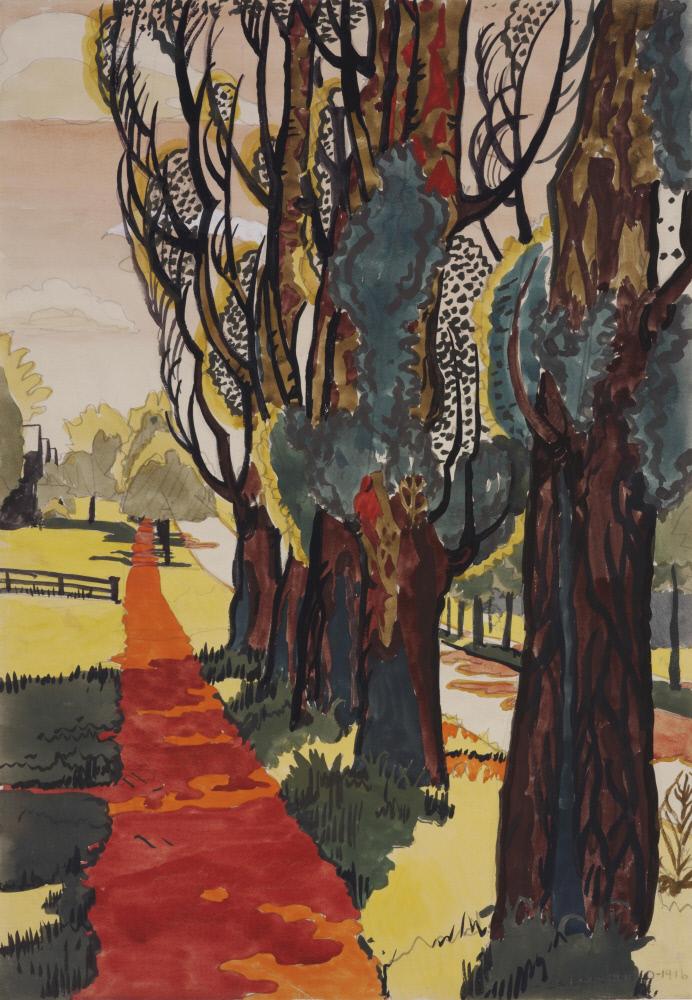
June 7, 1916: Charles Burchfield And A Hot Day In Ohio

We can intuit from looking at Poplar Walk (dated June 7, 1916) an extremely hot day.  It is no accident that the sidewalks are painted in a vivid orange, radiating heat even stronger than the yellow lawns; notice that the grass is only green where it is shadowed by the trees.

Those poplar trees are ecstatic, their branches arching upwaex into the light, their decorative foliage suggests that Burchfield had been looking at Asian art.

In 1916 Charles Burchfield graduated from the Cleveland School of Art.  At age twenty-three the artist was on the brink of the most creative period of his life. He spent that summer at his mother's home in Salem, Ohio.  

Burchfield's working method was to sketch outlines and make color notations in graphite, then apply watercolor over them. In Poplar Walk he left a few areas of the white paper show through drawing the eye deep into the distance.

The largest collection of Burchfield's work is housed in the Burchfield Penney Art Center in Buffalo, New York across the street from the Albright-Knox Gallery.

Image - Charles Burchfield, Poplar Walk, June 7, 1916,  transparent and opaque watercolor on white paper with color notations in graphite Munson Williams Proctor Art Institute, Utica, NY

21 June 2022

Paula Rego: The Dance

I can' prove it but I think Paul Rego saw Winslow Homer's Summer Evening although she said that the idea for the painting came  from her husband. Rego's paintings are  full of her fascination with such disparate subjects fairy tales, politics, and sexual transgression so it is hardly a stretch to see The Dance as a symbol for 'the dance of life. We see a woman standing alone as she watches two couples dance, one perhaps courting, the other of an obviously pregnant woman.  In the background is a trio -  grandmother, mother, and daughter. All her possible choices are  arrayed  under a full moon with harsh lighting and its attendant strong shadows.

Rego was rewriting history from the female point of view all her work. By her emphatic seriousness and a style of archaic realism, Rego conferred a symbolic status on them, valorizing their struggles and compromises.

Paula Rego was born in Lisbon, Portugal in 1935, an only child in a privileged family. At the time the country was ruled by the fascist dictator Antonio Salazar.  His regime was hostile to women, a Latin version of kinder, kuche, kurche, So, although Paula's mother began to draw at the age of four there was no chance that she could make a career of art.

In 1951 Rego moved to England to study art at the Slade School under the care of a guardian; her family was quite conservative although strongly anti-fascist. Her father commissioned her to create murals for a workers' canteen in 1952 but it was a decade later before she began to exhibit her work in group shows in London. 

The British Royal  Academy has described Rego as "one of Europe's most influential contemporary figurative artists."  In 2010 she was made a Dame by Queen Elizabeth for her contributions to the arts. Indeed the British were so fond of Rego that they routinely referred to her as a Portuguese-born British artist.

Rego died on June 8, 2022. Her granddaughter Grace Smart, a theatre designer, tweeted : "Paula Rego  was a fantastic and world changing artist, and grandma. She taught us how to sew, draw, put on eyeliner, and tell uncomfortable stories." That last may be what the late critic Robert Hughes was referring to when he remarked that if there were two or more people in a Rego painting something bad would happen to one of them.

Image: Paula Rego - The Dance, acrylic on paper mounted on canvas, Tate Museum, London.

14 June 2022

Winslow Homer: Summer Night

It may surprise us today but during his lifetime Winslow Homer's work received a mixed reception. Potter Palmer, an early collector of Impressionist art from Chicago, turned down Homer's offer to sell of Summer Night. So the painting languished for the rest of the decade on loan to the Cumberland Club in Portland, Maine.

But all that changed in 1900 when Homer included the work in his entry to the Exposition Universelle in Paris.  Among its  admirers were Claude Monet and Paul Cezanne, two very different artists.  After Summer Night was awarded a Gold Medal, the French government bought the picture, which is how it is eventually found a home in the Musee d'Orsay.  Summer Night is included in the Lafayette Database, a project of the Louvre museum that inventories all the American artworks held by French museums.

Summer Night was painted in Prout's Neck where Homer was living in the 1890s. We can almost hear the music two young women are dancing to and the crash and roar of the waves that their comrades on the shore  are spellbound by.  To make sound come at us off the canvas is nothing short of amazing. One of Homer's great gifts was his ability to evoke sensations in the viewer, arguably the  aim of the Impressionists, but to do it with a realist technique.

Image: Winslow Homer - Summer Night, 1890, oil on canvas, Musee d'Orsay, Paris.

07 June 2022

Judy Chicago: Rediscovering Praxilla of Sikyon


"Most lovely of the things I have loved and lost; the sunlight,

"next, bright stars, the moon,

ripe gourds, the fruit of apple trees, the pears."

               - Praxilla, circa 441 BCE 

Anyone who has read about ancient Greece has probably heard of Sappho of Lesbos. Born around 630 BCE, Sappho lived for approximately six decades; her lyric poetry earned her the sobriquet "the Tenth Muse."  Higher praise cannot be imagined. 

Praxilla was a native of Sikyon, a city-state on the Gulf of Corinth. It wasn't until Judy Chicago's Dinner Party  that proper tribute was paid to Praxilla of Sikyon, one of thirty-nine women honored with hew own specially designed place setting at a non-hierarchical triangular table. You can see in this photo some of the 999 women whose names are inscribed in gold on a white tile floor. More than four hundred women participated in the making  of The Dinner Party.

Lesser known than Sappho, in her day Praxilla was called "immortal tongued'", in a time and place  where women participated in public and religious events. Today her lyric poems survive only in fragments and paraphrases; primarily "table songs" they were meant to be sung after dinner as guests imbibed wine from drinking gourds. 

Image: Judy Chicago - Praxilla,  (from The Dinner Party), ceramic, textile, porcelain with rainbow and gold luster, 1974-1979, Brooklyn Museum, photo courtesy of the museum.