Learning to Talk, originally published in Great Britain in 2003, is likely to be the last book we will ever have from Hilary Mantel. Mantel died suddenly in September of 2022. Her publisher described her, accurately I think, as one of Britain's greatest novelists.
26 October 2022
Hilary Mantel: Stories Of Her Youth
18 October 2022
Raymond Han: The Many Shades of White
"Look how white everything is," Sylvia Plath marveled in her poem "Tulips." That's what I think when I look at paintings by Raymond Han. Of course these shades of white contain colors as you will know if you have ever watched white paint being mixed in a store.
An embroidered cloth gives structure to the china arranged on the table. A cream pitcher is the focus of the picture. A blue and white teapot is decorated with japonisme; opposite is a Japanese cup. Greenery in a small cup is a touch of unruly nature in the midst of order. A spoon, a fork, a desert plate, and a few other small items complete the tea table. Why does that teapot seem subservient to the cream pitcher?
I have looked at Still Life with Rose Geranium in person several times. Fittingly, a print of it hangs in the Terrace Cafe at the museum. It was my introduction to Raymond Han whose bravura handling of shades of white is the signature of his still work. A gentle version of photorealism, in contrast to the sharp edges in the work of Janet Fish or Richard Estes.
The term still life appeared in late 16th century Netherlands; in French it is nature morte or 'dead nature'. Intriguingly, the objects in a still life often appear to have individual personalities.
Raymond Han was born in Honolulu, Hawaii and lived near Oneonta in upstate New York for several years before his death in 2017. Han was one of seven children born to Korean immigrants. First he earned a scholarship to the Honolulu Museum of Art; then he moved to New York City where he studied at the Arts Students League.
Image: Raymond Han - Still Life with Rose Geranium Sprig, 1980, oil on canvas, Munson Williams Proctor Art Institute, Utica
08 October 2022
Jaune-Quick-To-See-Smith
"Where we lived, the settlers built their houses. Where
Jaune Quik-to-see was born on a reservation in Montana. Smith's first memory of making art was of dragging a stick through the dirt when she was three years old. As a small child, she treasured animal drawings of Growing up in poverty the girl found a way to create her own, more satisfactory world. Her pictures were a way she could share something with her father, an illiterate horse trader. Like many Native children of his generation, he had been taken from his family and sent a boarding school for deracination; when he spoke Salish, his mother tongue, the boy was beaten.
As a teenager, she was told by a counselor that "Indians don't go to college." When she persevered and enrolled at a college in Washington State, a professor told her that women couldn't be artists. She eventually earned an MFA in Visual Arts from the University of New Mexico. Fortunately, she ignored the advice. Smith only began to show her art in New York at age thirty-nine. Her work has received numerous awards over the years.
mage: Jaune-Quick-to-See Smith, 2021 acrylic and collage on canvas, courtesy of Garth Greenan Gallery, NYC.
27 September 2022
Pablo Picasso: Boisgeloup In The Rain
Boisgeloup is an old stronghold dating from the Middle Ages. The town is located in the French region of Haute-Normandie. It became the home of Pablo Picasso in 1930. He Made a studio where he built sculptures in plaster, iron, and bronze. On the property there was a large outbuilding where he installed a press for engraving. He lived there for six years with his mistress Marie Therese Walter while his wife Olga stayed in Paris. There is a small museum L'Atelier du sculpteur that displays his works.
Image - Pablo Picasso - Boisgeloup in the Rain, 30 March 1932, oil on canvas, Musee Picasso, Paris.
18 September 2022
Stella Polaris: Helen Frankenthaler
30 August 2022
Bob Thompson's Antique Figures
16 August 2022
Raoul Dufy: The Case For Beauty
"A well painted turnip is more significant than a poorly painted Madonna." - Max Liebermann
Not many artists are so distinctive that an adjective is coined in their honor but here is one: "Dufyesque."
Early on, Raoul Dufy (187-1953) became adroit at effacing the ugly, a talent that came in handy for someone born in Le Havre. Guidebooks agree the port city is one of the least attractive cities in France. With its hustle and bustle, Le Havre provided the animation that was a characteristic of his work. But give Le Havre credit for its municipal art school where young Dufy began his art education.
Raoul Dufy had seen a retrospective devoted to Vincent van Gogh two years before he painted La Dame en Rose. Until then Dufy had shown little interest in painting human figures. Van Gogh's influence is obvious in the use of black outlining and the halo of broken lines that makes the green room vibrate with energy. The uninterrupted line of nose and eye brow is an elegant gesture. No chair is visible although she appears to be sitting. The pink dress barely suggests her figure; it is her face that is the center of attraction. A sliver of a gray door at left and an orange triangle. are the only hints of a location. At first the identity of La Dame en Rose (The Woman in Pink) was something of a mystery. She is thought to be Eugenie Brisson, his future wife.
After his mandatory military service Dufy won a scholarship to L'Ecole des Beaux-Arts in Paris. During its brief heyday, bracketed by the Autumn Salons of 1905 and 1906, Fauvism was an experiment in color for its own sake that shook the staid French Academy to its boots. Dufy soaked it all up as he worked on improving his drawing skills.
By the late 1940s Dufy's ability to paint was so severely limited by rheumatoid arthritis that he had to fasten the brush to his hand. He died in 1953; the cause was intestinal bleeding, likely caused by his treatment with cortisone
Toward the end of his life Dufy saw himself dismissed as little more than an illustrator. Accused of lacking seriousness, his brilliant performance has been overlooked by his critics. In recent years though Dufy's star has been on the rise because so much contemporary art is cold and impersonal. Indeed, Dufy has been called a modern-day Watteau for his depictions of the divertissements of the bourgeoisie and their charming impermanence. "If Fragonard could be so gay about the life of his time, why can't I be just as gay about mine?" he retorted.
Image: Raoul Dufy - La Dame en Rose, oil on canvas, 1908, Pompidou Center, Paris.
05 August 2022
Jennifer Bartlett: Five In The Evening
27 July 2022
Fairfield Porter: The French Connection
What matter is that it is a wave.
What matters is that wave will return.
What matters is that it will always be different.
What matters the most of all: however different the returning wave,
It will always return as a wave of the sea.
What is a wave? Composition and muscle. The same goes for
lyrical poetry."
- Marina Tsvetayeva
By what alchemy do flat patches of color look like the waves of an incoming tide? A non-realistic painterly style characterized by flat patches of color is how, and that wave rolled in from France. I see the whitecaps as decorations on the blue/green breakers. Fairfield Porter's interest in decorative motifs was inspired by his admiration for the French artists known collectively as Les Nabis, in particular Pierre Bonnard. In his paintings Porter combined realism with flat abstraction; among his friends was fellow artist and abstract expressionist painter Willem de Kooning. Porter was a figurative painter in the post-war years when American abstract expressionism was triumphant. While at the Parsons School of Design, he studied with Jacques Maroger, a French art restorer.
During the Christmas holidays of 1938, Porter attended an exhibition at the Art Institute of Chicago of works by Bonnard and Edouard Vuillard. The exhibition came as a "revelation of the obvious" as Porter would recall to interviewer Paul Cummings in the 1960s. Why, he wondered, would he paint any other when way "it's so natural to do this." He also told Cummings, "I think that Ingres's remark that 'I leave it to time to finish my paintings' is true in a very wide and profound way."
Image: Fairfield Porter (1907-1975) - The Wave , 1971, oil on canvas, private collection
20 July 2022
Leon Dabo: A Late Romantic - Part II
Image: Leon Dabo - The Blue Vase, 1952, oil on canvas, Sullivan Goss Gallery, Santa Barbara.
13 July 2022
Leon Dabo: A Late Romantic - Part I
07 July 2022
Louise Bourgeois: Material Girl
28 June 2022
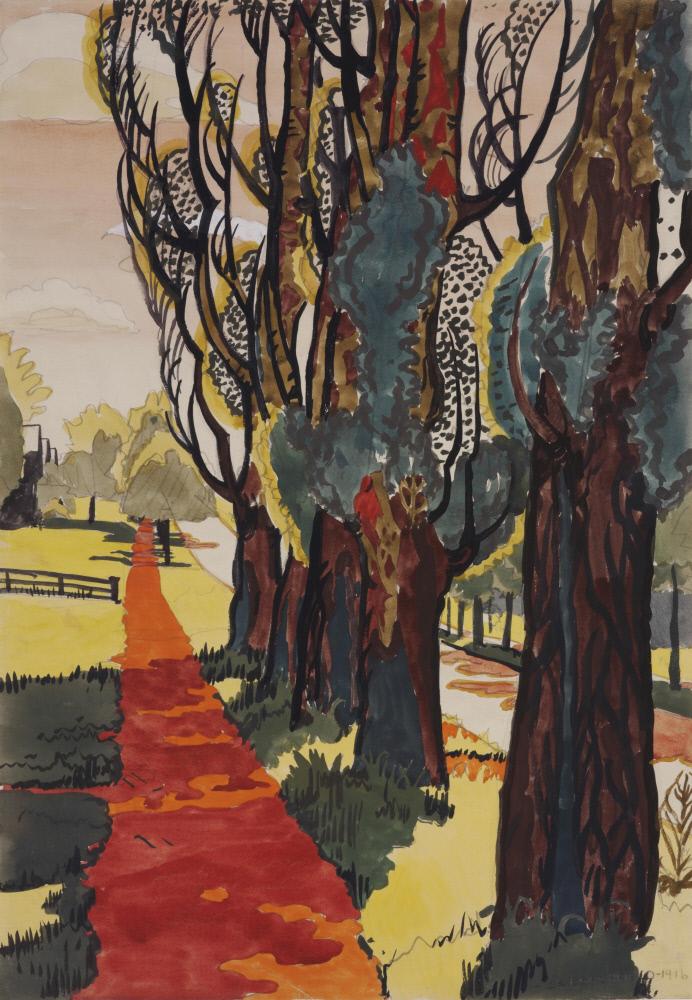
June 7, 1916: Charles Burchfield And A Hot Day In Ohio
21 June 2022
Paula Rego: The Dance
Paula Rego was born in Lisbon, Portugal in 1935, an only child in a privileged family. At the time the country was ruled by the fascist dictator Antonio Salazar. His regime was hostile to women, a Latin version of kinder, kuche, kurche, So, although Paula's mother began to draw at the age of four there was no chance that she could make a career of art.
In 1951 Rego moved to England to study art at the Slade School under the care of a guardian; her family was quite conservative although strongly anti-fascist. Her father commissioned her to create murals for a workers' canteen in 1952 but it was a decade later before she began to exhibit her work in group shows in London.
The British Royal Academy has described Rego as "one of Europe's most influential contemporary figurative artists." In 2010 she was made a Dame by Queen Elizabeth for her contributions to the arts. Indeed the British were so fond of Rego that they routinely referred to her as a Portuguese-born British artist.
Rego died on June 8, 2022. Her granddaughter Grace Smart, a theatre designer, tweeted : "Paula Rego was a fantastic and world changing artist, and grandma. She taught us how to sew, draw, put on eyeliner, and tell uncomfortable stories." That last may be what the late critic Robert Hughes was referring to when he remarked that if there were two or more people in a Rego painting something bad would happen to one of them.
Image: Paula Rego - The Dance, acrylic on paper mounted on canvas, Tate Museum, London.
14 June 2022
Winslow Homer: Summer Night
07 June 2022
Judy Chicago: Rediscovering Praxilla of Sikyon
"Most lovely of the things I have loved and lost; the sunlight,
"next, bright stars, the moon,
ripe gourds, the fruit of apple trees, the pears."
- Praxilla, circa 441 BCE
Anyone who has read about ancient Greece has probably heard of Sappho of Lesbos. Born around 630 BCE, Sappho lived for approximately six decades; her lyric poetry earned her the sobriquet "the Tenth Muse." Higher praise cannot be imagined.
Praxilla was a native of Sikyon, a city-state on the Gulf of Corinth. It wasn't until Judy Chicago's Dinner Party that proper tribute was paid to Praxilla of Sikyon, one of thirty-nine women honored with hew own specially designed place setting at a non-hierarchical triangular table. You can see in this photo some of the 999 women whose names are inscribed in gold on a white tile floor. More than four hundred women participated in the making of The Dinner Party.
Lesser known than Sappho, in her day Praxilla was called "immortal tongued'", in a time and place where women participated in public and religious events. Today her lyric poems survive only in fragments and paraphrases; primarily "table songs" they were meant to be sung after dinner as guests imbibed wine from drinking gourds.
Image: Judy Chicago - Praxilla, (from The Dinner Party), ceramic, textile, porcelain with rainbow and gold luster, 1974-1979, Brooklyn Museum, photo courtesy of the museum.
21 May 2022
Raoul Dufy: The Picture Stares Back
12 May 2022
Gabriel Orozco: A Porcupine Eats A Tortilla