23 April 2022

Charmaine Watkiss: Tenacity Serves the Warrior Well

"I learned to make my mind large, as the world is large, so that there is room for paradoxes."  -  Maxine Hong Kingston

Charmaine Watkiss iis a British artist whose parents emigrated from Jamaica.  She finds inspiration in the culture of the African Caribbean diaspora.

Watkiss works primarily with pencil and paper to create life-sized figures.  She uses material from history in ways that demonstrate the relevance of the past to the present. Tenacity Serves the Warrior Well is a self-portrait; the woman warrior wears a ceremonial floral collar and she radiates the power of the sun. Her hands are clasped calmly as she gazes into a distance we can't see.  The greenery behind her looks like Chinese brush painting so' looks like bamboo. to me!


Image: Charmaine Watkisss - Tenacity Serves the Warrior Well, 2022, watercolor and pencil on paper, courtesy of the artist, London.

11 April 2022

Jean-Baptiste Leroux: A Green Thought In A Green Shade

To those of us who love spring best of all the  seasons, we cherish it for the reemergence of the sensual world. Le jardin (French for ornamental garden)  and le potager (French for vegetable garden) compete for our ministrations. 

In "The Garden,"  British poet Andrew Marvell (1621-1878) imagined it as a place for  place for contemplating the beauty of nature, albeit  a highly  cultivated version.  As anyone who has ever donned a pair of gardening gloves knows there is a world of work that goes into cultivating that serenity.

Jean-Baptiste Leroux was born in Touraine, France. The Loire River meanders through the region and this  geographical  happenstance, made it a favorite of  Renaissance French kings. During the Hundred Years' War, Torraine became the seat of king, safely away from Paris. For its many elegant chateaus, the region was nicknamed "the Garden of France/" 

The young photographer Leroux made that journey in reverse.. In Paris he became the director of the Nikon Gallery in Saint-Germain-des-Pres. After meeting the owner of the nearby Chateau de Courance, Leroux began to exhibit his garden photographs. His favorite subjectss are gardens and architecture. His eponymous  Collection Jean-Baptiste Leroux is part of the Reunion of French National Museums.

Image: Jena-Baptiste Leroux - Potager, undated, color positive photography, Collection Jean-Baptiste Leroux, Paris.

25 March 2022

Spring: Weather of Expectation


Very little is known about this painting other than its title  Le printemps de la riviere du sud (Spring on a Southern River), said title likely given by the Musee Guimet where the painting lives. The artist's name and era are unknown but painting of colored inks on paper is  "antique" and China is the country where it was made.  Just because we don't know much doesn't mean we can't enjoy its  vision of flowers bursting from the cloudy winter waters.  I like to think of the flowers bursting up and out of the earth,\.

Musee Guimet was founded in 1879 by wealthy industrialist  Emile-Etienne Guimet to display his extensive collection of art  from southeastern Asia. He had assembled the collection at the behest of France's minister for  public education. On his travels Guimet visited Greece, Rome, and Egypt as well, so the breadth of the museum's treasures makes it a must-visit museum on a trip to Paris. 

Image: Le printemps de la riviere du sud, Musee Guimet, Paris.

12 March 2022

Ilya Kaminisky and Alexander Archipenko: Ukrainian Artists


'Years later, some will say none of this happened; the shops were pen, we went to see puppets in the park.

And yet on some nights townspeople dim the lights and teach their children to sign. Our country is the stage: when patrols march, we sit on our hands. Don't be afraid, a child signs to a tree, a door.

When patrols march, the avenues empty. Air empties but for the screech of strings and the tap tap of wooden fists against the walls." - "And Yet, on Some Nights" by Ilya Kaminsky, from Deaf Republic, Minneapolis, Graywolf Press: 2019

Alexander Archipenko (1887-1964) was born in Kyiv when it was part of the Russian Empire. After stuying at art schools there he moved to Moscow where he was able to exhibit some works in group shows. In 1908 he moved to Paris where he lived in La Ruche,  a Russian art colony. While in Paris his sculptures earned him th nickname "the father of Cubist sculpture.

Archipenko emigrated to the United States in 1923, becoming a citizen six years later. He broke with the neoclassicism of Rodin and Maillol; he reimagined the human figure in three dimensional space through contorted planes set in negative space.

Ilya Kaminsky was born in Odessa in 1977 when Ukraine was one of the union of Soviet Socialist Republics. Kaminsky is hard of hearing as a result of a case of mumps he suffered as a small child.  The Kaminsky family was granted political asylum in the United States in 1993 because of Ukrainian anti-semitism.  Ilya Kaminsky settled in Rochester, New Yotk.  He has published two collections of poetry Dancing in Odessa (2004) and Deaf Republic.(2019). Three Per Cent, published monthly by the University of Rochester Press has been inspired by Kaminsky's championing of literary translation.

Image: Alexander  Archipenko - Carousel Pierrot 1913, paint on plaster, Solomon R. Guggenheim Museum, NYC.

08 March 2022

Inimitable Rose Wiley


"Wife and servant are the same,
  But only differ in the name:"
    - Lady Mary Chudleigh (1656-1710), from "To The Ladies"

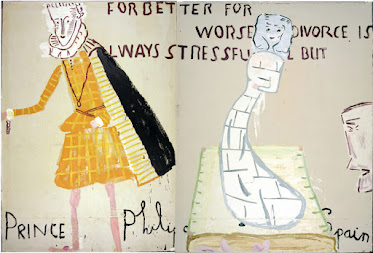
"for better for worse divorce is always stressful but..."

Rose Wiley's paintings have an exuberance that, once seen, is unforgettable. Her sources cut a broad swath through visual media - and from every period in art history - greeting cards, comics, magazines and newspapers, film stills.  She combines figures and texts from these and other sources, creating new stories .she calls "personal visual diary-making." 

The genesis of Lords And Ladies was ab article about a divorce that appeared in The Guardian newspaper. A bride stand on a wedding cake while her husband flees the scene. He is modeled on Philip IV of Spain as he appeared in a portrait made nu 1620 by Rodrigo de Villandrando. (in the collection of the Prado in Madrid). The lettering for the bride's words forms a lattice pattern whiles Philip's title looks like a signature

Wylie usually paints by placing an upstretched canvas on her studio floor. This enables her to make gestural brushwork that makes for an improvisational feel to her work.

Rose Wiley was born in Kent, England in 1934.  She graduated from the Royal Academy of Art in 1981, although she had studied at the Folkston School of Art in the 1950s. Like many women of her generation, Wiley was sidetracked from her career when she married a fellow artist and raised three children. 

Image: Rose Wiley - Lords And Ladies,  2008, oil on canvas, National Museum of Woman in the Arts, Washington, DC.

28 February 2022

Louise Moillon: A Bunch Of Asparagus


"someone will remember us/ I say/ even in another time." - Sappho, Fragment 147

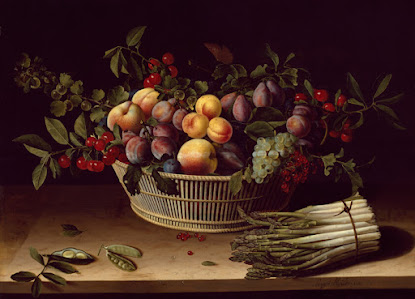
In full, the title of this painting is Fruit Basket With A Bunch Of Asparagus but the foretaste of spring in the  bunch of asparagus is irresistible. The eye is drawn by a spotlight of mysterious  origin to the to the lower right quadrant of the canvas. Against an indeterminate backdrop,  fruits and vegetables are rendered with a naturalism replete with elegance as well as clarity.

Most of Louise Moillon's paintings were made between 1629 and 1637;a short but impressive career bracketed by a long life. Her father and stepfather were artists and art dealers who provided the young Louise with a workshop, training, studio space of her own, and - crucially - clients for her work. Who her primary teacher was is uncertain although her uncle has been suggested. Eventually  King Charles the First of England acquired five of  Moillon's still lifes  for the royal collection. Indeed, during her lifetime, Moillin's work was widely admired but, like so many other female artists, her reputation faded after her death for lack of champions.

Louise Moillon (1610-1696) was born in Paris; her family resided in the Pont Notre Dame section of the city, a haven for French Protestants who had been forced into internal exile by ferocious religious wars between Catholics and Protestants. Thanks to her father's participation in art local fairs, the young Louise came to know several Dutch painters.  Their influence on her style is apparent. Her still life paintings are ensconced in the atmosphere that Lawrence Gowing identified in the paintings of Vermeer aas "an envelope of quiet air."

Image: Louise (Louyse) Moillon - A Basket Of Fruit And A Bunch Of Asparagus, 1630, oil on wooden panel, Art Institute. of Chicago.

13 February 2022

On The Avenue With Marisol Escobar

Strolling along Fifth Avenue is to experience a real life catwalk; it's a ritual that has a long and storied history. Marisol Escobar's society lady in On The Avenue is impossibly slim with impressively long legs. Cloaked in a 1960s sheath, she wears two accessories that were de riguer then: a little dog and a hat. And that hat looks like the artist planted a Ponytail palm on her head. I know, because there is one just like it sitting in my living room. Ponytail Palms are not actually palms which is only fitting as fashion works best with a pinch of artifice. For Marisol, mimicry was useful for critiquing  sexual politics in a way both pointed and fanciful.
 
Marisol studied with the Abstract Expressionist painter Hans Hoffmann in the early 1950s but her sculptures began  to prefigure Pop Art by the late fifties. So it was hardly surprising that she attracted the attention of  Leo Castelli, whose Manhattan gallery, opened in 1957, became the forward outpost of Pop.
 
Seymour Knox, a founder of the Albright-Knox Gallery in Buffalo. purchased several works by Marisol in the early 1960s for the museum. Whenever I would visit the city I looked forward to seeing The Generals (1961-62). Simon Bolivar and George Washington sit astride a larger-than-life sized wooden horse. Another favorite of mine, Baby Girl (1963), shows a little girl sitting with a Marisol doll om her lap. An early critique of the postwar culture that infantilized  women?

Marisol had a cosmopolitan personality that fit the New York art world nicely. Born in Paris to wealthy Venezuelan family, Marisol grew into a worker bee in art.   "(C)onside ring her work habits, the frequency with which she appears at uptown art openings an parties is nothing short of astonishing."  

With the loss of her longtime dealer Sydney Janis in 1989 Marisol lost a gallerist whose simpatico with her work would be not be easily replaced. The Albright-Knox Gallery has long been home to the largest collection of Marisol's work: when she died, Marisol left her estate to the museum.

Image: Marisol Escobar - On The Avenue,  1961-62, acrylic paint and graphite on plaster and wood.

20 January 2022

Cubist Cheese


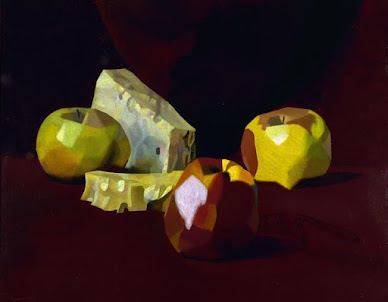
For some unfathomable reason the British writer G.K. Chesterton started the rumor, "Poets have been mysteriously silent about cheese."

In this still life by Luis Fernandez, there is Swiss cheese in front, I think ,and a brick of Stilton (possibly) in back. As for those apples, all  angles and marmoreal faceted surfaces,  they remind me of glass paperweights. Welcome to the world of Cubist cheese. Salvador Dali's notorious limp watches  in The Persistence of Memory (1931), were inspired by Camembert.  Cheese in art has a long and intriguing history.

How cheese is aged is a story in itself.  Affinage is the process of aging cheese in a cave; an affineur is a person who tends these works in progress for months or even years, until they are ready to be eaten. Other French terms are fromage (cheese), fromager (a cheese monger) and fromagerie (cheese shop). All cheeses that have rinds need to be aged in a cave. And the rinds need to be carefully monitored, high humidity maintained and mold evenly brushed over the surface of the wheel at regular intervals. What this means is that during the pandemic, affineurs are essential workers.

On Sunday, September 26, 2021, a group calling themselves 315 Foodies (for the Central New York Area Code 315) met to assemble what the Guinness Book of World Records was on hand to certify as the world's longest charcuterie board at 315 feet. Cheese mongers from around the region took part, using wooden cheese boards that interlocked like puzzle pieces; each board one foot long.

Before there was cheese in upstate New York, there was water.  About 11,000 BCE, a glacial waterfall carved out the gorge where Little Falls now stands. From this point, rivers to the east drain toward the Atlantic and to the west the fluvial deposits go toward the Great Lakes.  The Mohawk River gorges and the Erie Canal, both running east to west, made a flourishing mill culture that brought prosperity to Little Falls -  grist mills, paper mills, flour mills, sawmills, and textiles mills.

During the second half of the 19th century the city was known as "the cheese capital of the world," thanks, in no small part,  to the promotional zeal of local newspaperman Xerxes Willard. Then, as now, dairy farming and cheese making are important to the New York State economy. The Chobani yogurt Company was founded in 2005 by a Turkish immigrant in South Edmeston, a hamlet located south of Little Falls.  

Note: History records three painters named Luis Fernandez, one a 17th century Spanish history painter, one a contemporary Venezuelan, and this Luis Fernandez (1900-1973) , an Asturian artist who studied at the School of Arts and Crafts in Barcelona.  In 1924 Fernandez moved to Paris where he met Braque, who introduced him to Cubism.  Fernandez died in Paris in 1973.

You can order a wide selection of chesses and other comestibles at Calle1945.

Image: Luis Fernandez - Nature morte, pommes et fromage (Still Life with Pommes and Cheese), no date given, oil on board, Musee d'arte moderne, Paris.

06 January 2022

Landscape With A Tree Of Light: August Macke


"What I most cherish is the observation of the movement of colors." - August Macke

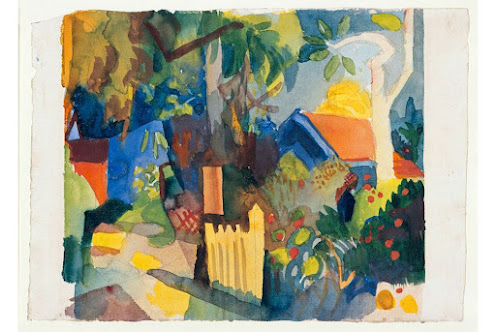
The image of a tree of light evokes thoughts of spring , two months away or almost a year in the past, depending on your January mood. August Macke's mood in his Landscape With A Tree Of Light is one of sun-bathed wonderment. There is an all-at-once quality in Macke's pictures that suggests an acquaintance with Italian Futurism. His painter friend Franz Marc characterized Macke's  special gift as "a brighter and purer sound to color than any of us; he gave it the clarity and brightness of his whole being."

August Macke (1887-1914) was born in Westphalia and died on the battlefield at Champagne during the second month of World War I. Although he was just twenty-seven, his artistic career was already  eight years, At his death, Macke had produced some 600 paintings. He had painted his first watercolor when he was fifteen. With his friend Franz Marc, the two founded Der Blaue Reiter (The Blue Rider), a group of German Expressionist painters. 

Meeting Robert Delaunay was the pivotal artistic relationship in Macke's career; the older painter's chromatic Cubism altered Macke's use of colors. Nevertheless, Macke continued to portray scenes of everyday life, a subject matter he had learned earlier from the Impressionists. 

\Image - August Macke - Landschaft mit hellum Baum (Landscape With A Tree Of Light), 1914, watercolor overlaying pencil, State Museum, Berlin.

01 January 2022

Happy New Year

Come, children, gather round my knee;
Something is about to be.
Tonight's December thirty-first,
Something is about to burst.
The clock is crouching dark and small,
Like a time bomb in the hall.
Hark! It's midnight, children dear
Duck! Here comes another year!

 - "Good Riddance, But Now What?" by Ogden Nash


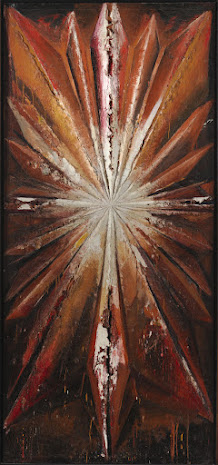
The  artist Jay De Feo (1921-1989) was admired fort the fearlessness of her work. Born Mary Joan, she acquired the nickname Jay as a girl. Her mother was a nurse and her father was a traveling doctor with the Civilian Conservation Corps: eventually Jay and her mother settled in California.

 In 1959, the year she painted The Jewel, De Feo became a member of Bruce Connor's Rat Bastard Protective Association in San Francisco. Also, that year her work was included in a group exhibition at the Museum of Modern Art in New York..  The year before De Feo had begun work on her monumental painting The Rose, which would take ten years to complete.

Image Jay De Feo - The Jewel, 1959, oil on canvas, Broad Museum of Contemporary Art, Los Angeles.
 

24 December 2021

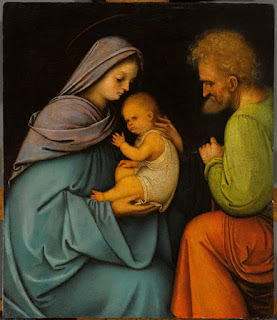
Giovanni Agostini da Lodi: The Holy Family

According to the Italian Malaguzzi Valeri, he definitively identified the artist in 1912.  The American expatriate Bernard Berenson  gave himself credit for the attribution, dating the discovery to 1890..  Given his track record, I am inclined to doubt Berenson but the one they agreed on was that the identification of of the late 15th century Lombard painter took four hundred years. We may also consider that the esteemed art historian Adolfo Venturi sided with Berenson.

Moving between Milan and the Veneto, Agostini da Lodi  was a bearer of Milanese style to Venice. His contemporaries prized the artist's work for its extravagance. but I like this Holy Family for its directness and simplicity. These qualities would have enhanced its power to make the Nativity vivid for n audience that mostly could not read and did not have direct personal access to Biblical stories.

Image: Giovanni Agostini da Lodi - The Holy Family - oil on wood pane, 16th century, Louvre, Museum.

21 December 2021

Winter Solstice


 "Let us love winter, for it is the spring of genius."  - Pietro Aretino (1492-1556)

The shortest day brings with it the longest night.  Time to  begin the season of vitamin D cocktails.

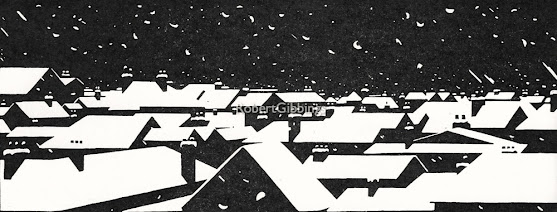
Robert Gibbings (1889-1958) was an Irish artist, born in Cork.  His family opposed his intention  to study art but Gibbings persevered, eventually enrolling at the Slade School in London.  Among other media, Gibbings made wood engravings and from 1924 to 1933 he ran the Golden Cockrell Press.. He also illustrated books on travel and natural. history.  In an astonishment, he became the first person known to have made drawings under water. He was buried on the banks of the River Thames in the village of Long Wittenham.

Image: Robert Gibbings - Dublin Under Snow, woodblock print, vourtesy of Grive Press, New York.

11 December 2021

Richard Florsheim: A Man For The Season

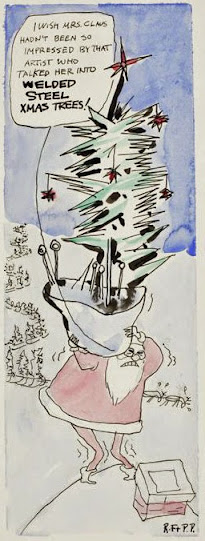
Ten years ago I received this Xmas card from Joanne Molina, editor of the online decorative arts magazine The Curated Object. As a Chicagoan, Joanne was familiar with the satirical lithographs of Chicago native Richard Florsheim (1916-1979). Their whimsical qualities delighted me. 

I discovered  hundreds of Florsheims.  There are many landscapes that hint at the influence of Emile Bernard on the younger artist and they are worthy of attention but it is Florsheim's delight in the foibles of artists and their followers that makes merry. 

Apparently, many Florsheim 'cartoons' date for the late 1950s, a moment of high seriousness and outright pomposity in the art world. The preferred mode in criticism was American triumphalism and its chief promoter was Clement Greenberg, who regarded the U.S. - and probably himself, truth be told -  as the arbiter of "advanced " art in contrast to the no so distant Nazi rampage through the art collections of Europe. Pop Art as a provocation was yet to come.

The "tablets brought down from the mountain" tone that Greenberg perfected has survived as the lingua franca for critics hoping to be taken seriously. In contrast, Florsheim's deflationary tactics are witty.  The man was no mean-spirited Philistine; he was an artist with serious credentials. There is exponentially more money at play in today's art world than there was in the post-war world but human nature remains pretty much the same as it did in the Florsheim School of Artists.

In the art world according to Florsheim, sculptors are presented as a wacky bunch. Take one Shistokovich, whose scrawny, angular figures are refractions of Giacometti characters.  Or Bolofinsky (H)e always did say that someday the world would catch up with him.") whose outdoor metalscapes  were forerunners of the television antenna. An apartment dweller thinks that the profusion of antennas .atop his building means that Bolofinsky's work is "selling like hotcakes." A work by Messovich titled Bald Ego looks like a patient on a psychiatrist's couch. Florheim's delight in naming his characters reminds me of a comment that was made about Constance Garnett, the British translator who introduced the great Russian writers of 19th century to e English-speaking readers. Her achievements were heroic but she has also been accused of creating one great lumpen writer named Tolstoyevsky.


Richard Aberle Florsheim (1916-1979) came from a wealthy Chicago family. After studying from the University of Chicago, Florsheim spent two years abroad (1936-38) where he worked in the atelier of the French post-impressionist painter Emile Bernard and showed his work at the Salon des  Refuses. Returning to Chicago in the summer of 1939, Florsheim rented a studio of his own. There he began making lithographs and had his forst exhibition in 1942.

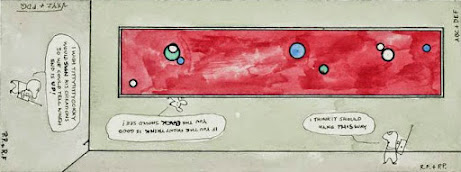
Images by Richard Florsheim are in the collection of the Art Institute of Chicag:
1.  Welded Steel Xmas Trees
2.  I think it should hang this way.

29 November 2021

Raoul Dufy: A Version Of Pastorale


"It is a defect of God's humor that he directs our hearts everywhere but to those who have a right to them." - Tom Stoppard, from the play Arcadia (1993)

It's harvest time in Raoul Dufy's Arcadia,  Langres, a commune in northeastern France, where autumn  is sometimes foggy, wet, and even snowy.

But this is Dufy's Arcadia, so unpleasant conditions have been banished.  This is a place where sheep may safely graze indeed. In the far background  there are rows of laborers mowing and reaping. In the lower left corner there is an empty hayrick which draws our eyes to remnants of an antique Arcadia, a celebratory urn atop a pedestal and, this being a painting by Dufy, there is a lissome reclining woman,, her clothes nowhere to be seen. An open air social event, perhaps.  Harvesting has never looked this festive.

On a serious note, Dufy's particular contribution to modernism was to marry formal avant-garde principles to a decorative aesthetic. 

Image; Raoul Dufy - Harvest At Langres, circa 1938, Musee d'arte Moderne, Paris.

14 November 2021

Helen Frankenthaler's Butterfly


One of the most consistently beautiful abstract painters was Helen Frankenthaler. (1917-2011), a quality often held against her work by male artists. It's something we now admire in her work, seen here in Madame Butterfly. Spread across three sheets of paper, two blue-green curvilinear strokes suggest  butterfly wings.  Although Helen Frankenthaler has violated a cardinal rule of composition -  that symmetry can be boring -  she has resolved the problem with asymmetrical washes of delectable color.  Wabi sabi, a traditional Japanese aesthetic with its appreciation for the beauty of imperfection\is seen here as three against two. Frankenthaler bought  a Japanese screen on one of her many trips to Kyoto where she worked with master print Kenneth Tyler at Tyler Graphics Studio, beginning in the 1970s

Zen principles appealed to Frankenthaler and her contemporaries in the Abstract Expressionist movement of the 1950s as a path to individual expression; an influence  Frankenthaler strenuouslyy denied.  But here are undeniable echoes of Japanese calligraphy in her style and in the delicacy of her technique.  

You can't see them from this reproduction but  Frankenthaler's Madame Butterfly is composed of more than one hundred different shades of color. Frankenthaler employed forty-six separate wood blocks for a symphony of tones and textures. Like her paintings, Frankenthaler's prints appear spontaneous although she planned her moves rigorously. As for the title, it alludes to Puccini's tragic opera about a geisha's love for an American naval officer; the artist usually named pictures after she finished them.  In Madame Butterfly we see both the  beauty  of Puccini's protagonist and  of a Japanese print.

A three-fold painting that originated in the early Middle Ages, the triptych was usually executed on wood panels, used as altarpieces in Christian churches. Frankenthaler's triptych is also large, measuring 41.75x 79.5 inches. 

Image; Helen Frankenthaler - Madame Butterfly, 2000, woodblock print on paper,  Frankenthaler Foundation, NYC.

21 October 2021

Pia Camil: Tunic

"A ship arrived from Valpariso

Dropped its anchor in the bay

Her name reminded me of kingdoms

Sunlit countries far away." 

- excerpt from "The Ship" by Oliver St. John Gogarty


Pablo Neruda wrote "An Ode To Valpariso" in tribute to the seaport that refreshed him whenever the ennui of "the tiredness of Santiago" weighed on his spirit. 

A cross between a monumental kimono and a painting by Frank Stella?  Valpariso Green Cloak for Three (81  in. x175 in.) Camil fashioned the series she calls Skins from  cloth discarded  by textile factories.  She titled the works in tribute to Frank Stella's geometrical pictures; they were inspired by the colorful traditional Mexican ponchos and serapes.  Each one is capacious enough to hold more than one person.

Pia Camil was born in Mexico City in 1980; after studying art at the Rhode Island School of Design and then at the Slafe School in London, she now lives and works in her native city.

Image: Pia Camil  - Valpariso Green Cloak Form Three , 2016, stitched fabric, photograph courtesy of the Clark Art

10 October 2021

Emma Amos: The Artist As A Young Woman

"All the little children loved the things that I drew and I did masses if paper dolls and things. And then it got rally serious and people thought 'oh, she can really draw. So, they gave me things to copy ... they gave me everything that was going, coloring books and things to copy."                                           - Emma Amos to Al Murray in an interview for the Archives of American Art at the Smithsonian Institution, October, 1968.

When she was twenty-three Amos moved to New York from Atlanta, having found the southern city's art scene too sleepy for what she aspired to do with her art. As it would turn out, sleep was not something Amos would be getting for the next several years.  By day, Amos worked as a textile designer, by night she studied full-time for her Master's Degree at New York University, and on the weekends she painted. 

While she was at it, Amos became the youngest an sole female member of the African-American art collective Spiral, a group that had been founded in 1963 by Romare Bearden and Norman Lewis. to name but two of the fifteen members. In the 1970s  Amos became involved in the production of the feminist arts journal Heresies  and was an original Guerilla Girl in 1985.

If thinking about this makes you tired, I know the feeling. Because I spent my twenties working full-time during the day, going to school full-time at night, spending my spare time engaged in feminist and other political activities. Up at 6:30 each morning and returning from classes at 11:15 at night.

First Avenue Window comes from this early period in Amos's career.  Spiral had rented a downtown space on Christopher Street in 1965  for its first and only exhibition in May of 1965.  Shortly after, the group disbanded.  Although the artists conformed to no one style, we can see in this painting by Amos an eclectic and even irreverent approach to abstraction. 

Amos had been resistant to being categorized as a black artist, as bell hooks would  note in 1993, "[That] little girl who was dreaming of being an artist wasn't thinking, 'I'll grow up and be a Black woman artists,' but "I'll grow up and be an artist." And yet, in New York Amos was rebuffed by the (male)art scene as a woman; a rude shock for a young artist who had grown up in a middle-class family in Atlanta where people like W.E.B. Dubois and Zora Neale Hurston were frequent guests. 

Amos died from complications of Alzheimer's disease in 2020 at the age of eighty-three.

Image: Emma Amos - First Avenue Window, 1966, oil on cnavs with handmade, hand-painted frame, courtesy of Ryan Lee Gallery, NYC.

28 September 2021

Hans Memling: The Naughty Priest

Something to think about when you look at old portraits is that they were usually the product of several sittings, providing the artist ample time to consider the nature of his subject. The conventions of Renaissance portraiture were naturalistic in some respects but truth-to-life watts-and-all was not what either sitters or patrons waned.  In Hans Memling's portrait of the cleric Gilles Joye there is no hint of Joye's worldliness and vanity. The artist gives us a conventional priestly  image: hands clasped piously as if in prayer, a face full of solemnity above a modest clerical robe. 

The Canon Gilles Joye lived in what is now Belgium but he is usually described as  Franco-Flemish, having been born in the city of Kortrijk in West Flanders and then migrating to Bruges.   

Gilles Joye was appointed a singer at the Burgundian court chapel in Bruges in 1462. Unsurprisingly for one so irreverent, his vocal compositions were secular,. How this man became a rector is curious; his hobbies were street brawling, patronizing brothels, and even making a prostitute named Rosabella his mistress. \He was notorious for skipping out on his singing duties but was apparently forgiven because his music was so melodic and lyrical. Admonished to renounce his girlfriend, teh wag wrote her a Mass. (O rosa bella). Notwithstanding his transgressions, when Joye died he was buried in the church of St. Donation.

Hans Memling painted in the style known as Flemish Primitive; his portraits  simplified versions of his sitters' features. Born in the Rhine region he moved around northern Europe in search of commissions. After a stint in the Brussels workshop of Rogier van der Weyden he arrived in Bruges where he  was made a citizen in 1465. There he  became a leading painter with his own workshop. and it was there he met the cleric Gilles Joye. 

Image: Hans Memling (circa 1430-1494) - The Canon Gilles Joye, no date given but probably after 1465, tempura and oil on wood panel, Clark Art Institute, Williamstown, MA.

21 September 2021

Fred Wilson: The Museum Is The Message

"I trust the visual to communicate my ideas. I try to unlock the meaning of objects and eliciting a conversation by juxtaposing between them that creates an unexpected, but essential, thought." - Fred Wilson

"I get everything that satisfies my soul from bringing together objects in the world, manipulating them, working with spatial arrangements, and having them presented in the way I want to see them." - Fred Wilson

Five busts of the Egyptian queen Nefertiti that question what we think we know about the ancient world. The original bust by an anonymous artist has long been a  staple of art history texts. Grey Area (above) by the American artist Fred Wilson makes visible our changing understanding of who historical figures actually were.

Born in the Bronx in 1954, Fred Wilson describes himself as African, Native American, Amerindian, and European, a background ....While studying for his Fine Arts degree at SUNY Purchase, he worked as a guard at the Neuberger Museum on campus.  As I know from talking with museum guards, they spend enough time with works of art to make astute comments about how art is presented and how that shapes the viewer's reception.  From that experience Wilson drew a lesson: change the context and you change the meaning.  So it was that he made a version of the mythological character Atlas weighed down by art history books with a book on black artists at the bottom of the pile.

After stints at the Metropolitan Museum and the Museum of Natural History (on opposite sides of Central Park) Wilson realized that the two institutions presented similar objects in widely divergent ways. He has come to  specialize in presenting objects based on considerations that may be unimportant to most curators or that have gone unnoticed until Wilson put things together.  Mining the Museum he called it when he restaged galleries at the Maryland Historical Society in 1991. In a technique he has often used, Wilson renamed a painting Country Life that showed a plantation family at leisured Frederick Serving Fruit  for a young black slave boy in the picture. This  In a nearby vitrine, Wilson paired a stark set of slave shackles surrounded by  an .... adorned silver tea service, the embodiment of wealth produced by slave labor.

Fred Wilson was the first black artist to represent the United States at the Venice Biennale in 2003. with  the exhibit Speak Of Me As I Am (a reference to Shakespeare's character Othello, the Moor of Venice). So popular was Wilson's exhibition thatt there were waiting lins outside the American pavilion.  For Venice, a city where black people had been present for centuries, Wilson created a project that included an awareness of the city surroundings.

A last minute addition, Wanderer was a black-face courtier figure Wilson saw in the lobby of the hotel he was staying at. He replaced the face with a globe whose black oceans were crisscrossed by by white dotted lines that trace the routes of ships used in the slave trade.

Simone Leigh will be the first black American woman to represent the U.S. at the Venice Biennale in 2022.

For more about Fred Wilson

Images:

 1. Fred Wilson - Grey Area - pant, plaster, and wood, 1998, Brooklyn Museum.  2. Fred Wilson - Atlas, 1992, paint, plaster, and wood, Denver Museum of Art.  3. Fred Wilson - Wanderer, 2003, painted wood and printed paper, Berkeley Art Museum, Berkeley, CA.

10 September 2021

For Eighty Cents!: Angelo Morbelli


 "Italy is made.  We have still to make the Italians."

     -  Massimo D'Azeglio (1798-1866).  D'Azeglio did not live to see Rome designated as the capitol of new Italian state in 1871 but the Risorgimento (Resurgence) was almost complete when  the statesman/ novelist/painter died.

Look at these women cultivating rice: they are the 'essential workers' of 19th century Italy. Just for clarification, the title For Eighty Cents! indicates the anger of the painter Angelo Morbelli at the wage paid to rice farmers in the Po Valley circa 1890.  Indeed, working conditions for the women who worked the fields of the Piedmont region were so shameful that a name was coined for them - the mondine. We know there is a sky above from its reflection in the water the women stand in but the artist allows us no more respite from the prospect of their back-breaking toil than their overlords permitted. By using the broad horizontal canvas typical of landscape painting, we can almost feel the weight pressing down on the hunched figures.

The path fir Italian artists in the 19th century was not the triumphal march that historians ascribe to the French Impressionists. Stylistically, the Italians were all over the place and, on this account, art historians have not been kind to their works. Yet these artists made lively and daring experiments, more so than the Italian peninsula had witnessed in a long time. Together painters as varied as Silevstro Lega, Emilio Longoni, Plinio Nominelli, an Aneglo Morbelli were dubbed I Macchiaiolli (meaning painters of patches of light). 

Morbelli and his fellow artists were berated from all sides, for choosing ugly and unpleasant subjects rather pleasing ones that the bourgeoisie could hang in their parlors and, at the same time, for imbuing ugly realities with dignity and even nobility.  The Roman poet Horace had that art's purpose was to "instruct and delight" but the Macchiaioli would have none of that.

Full of idealism, they found their inspiration in the economic upheavals that accompanied political unification. Like their painterly styles, their politics were all over the  ran a gamut from progressivism to anarchy. The early 1890s were a period of strikes and protests in  northern cities where workers labored for impoverishing wages, under poor working conditions, if they could find work at all. Conditions were no better for the poor in rural areas where new industrial workers had migrated from.

Image - Angelo Morbelli- For Eighty Cents!, 1895, oil on canvas, Civico Museo, Borgogna.

.